
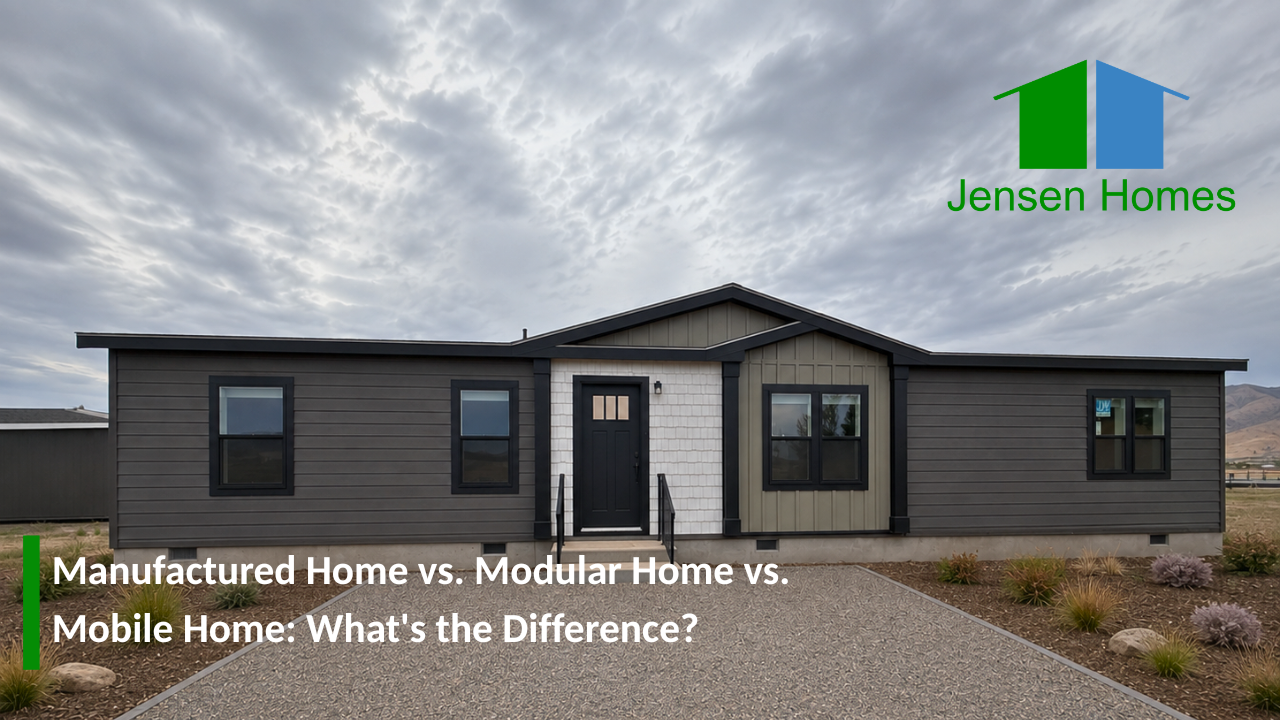
Manufactured Home vs. Modular Home vs. Mobile Home: What's the Difference?
If you've been shopping around, you've probably noticed these three terms get used almost interchangeably, even though they're not the same thing. It's a common mix-up, and it's not your fault. The terminology has changed over the decades, and a lot of outdated language still sticks around in everyday conversation.
Here's a breakdown of what each term actually means:
Mobile Homes: The Older Term
"Mobile home" is technically an outdated term. It refers to homes built before June 15, 1976, when the U.S. Department of Housing and Urban Development (HUD) introduced its first federal building code for these homes.
Before that code existed, there was no standardized set of safety or construction requirements, so quality varied a lot from one home to the next.
You'll still hear "mobile home" used casually today to describe any factory-built home. But if it was built after 1976, it's technically a manufactured home. The two terms get used interchangeably in everyday speech, so don't worry if you've been calling it a mobile home. Most people do.
Manufactured Homes: Built to a Federal Standard
A manufactured home is what most people picture today when they say "mobile home." These homes are built entirely in a factory, then transported to their final site. They're constructed to the HUD Code, the federal building standard that took effect in 1976.
That code covers structural design, fire safety, energy efficiency, and plumbing, and it's updated periodically to keep pace with building science. This gives manufactured homes a consistent baseline of quality no matter which state they're built in.
A few things that set manufactured homes apart:
- Built on a permanent steel chassis, which stays part of the home even after it's set on-site
- Can be set on a permanent foundation or on blocks and piers, depending on your site and preferences
- Constructed entirely indoors, so weather and material damage are less of a factor during the build
- Available in single-wide, double-wide, and triple-wide configurations
- Often more affordable per square foot than site-built homes
If you're looking at floor plans from major manufacturers like Cavco, Champion, Clayton, or Marlette, these are manufactured homes, built to that same HUD standard, with a wide range of layouts and finish options.
Modular Homes: A Different Building Process
Modular homes are also built in a factory, often the very same factories that build HUD-code manufactured homes. But the similarities mostly end there. Instead of the HUD Code, modular homes are built to state and local building codes, so standards can vary depending on where the home will be placed.
Modular homes are then transported to the home site on a removable steel chassis, which is taken off once the home is set permanently on its foundation. Manufactured homes work differently. Their chassis stays part of the home.
At Jensen Homes, that difference is really only building code based. Walk inside one of our homes, from the carpet up, and you won't be able to tell whether you're standing in a manufactured home or a modular one. Same craftsmanship, same finishes, same attention to detail. The distinction is in how the home is built and set, not in the quality of what you're living in every day.
Key differences with modular homes:
- Built to local and state building codes, not the HUD Code
- Transported on a removable chassis, then set on a permanent foundation
- Often built in the same factories as manufactured homes, just to a different code
Why the Difference Matters
Financing. Manufactured and modular homes are sometimes financed differently, depending on the lender and whether the home sits on a permanent foundation.
Where you can place it. Some communities have specific zoning rules for manufactured versus modular homes, so it's worth checking local regulations or HOA requirements before you move forward.
Timing. Because modular homes are built to a specific set of local and state building codes, factories need extra time to confirm what's required for your area. This can add as much as six months to the build timeline, and thousands of dollars to your total cost.
There's no universally "better" option here. It depends on your budget, timeline, and what you're looking for. Manufactured homes tend to be more budget-friendly and quicker to move into, since they're built entirely off-site with shorter lead times. Modular homes can offer more design flexibility and blend seamlessly with site-built homes nearby, but they typically cost more and take longer to build.
Have Questions? We're Here to Help
Sorting through the terminology can feel overwhelming, especially when you're just trying to find a home that fits your family and your budget. At Jensen Homes, we've spent decades helping families across Idaho, Nevada, and Oregon understand their options and find a home that works for their life.
Ready to explore your options? Browse our floor plans or contact Jensen Homes today. We're happy to help you figure out exactly what fits.